Threats to Coral Reefs
Since the 1970’s reef around the world have rapidly degraded. NOAA has estimated that nearly 90% of live corals in the Florida Keys have died in the last 40 years1. They are one of the most threatened habitats on earth. Corals are extremely slow growing, taking hundreds to thousands of years to grow an entire reef, and despite many corals’ rock-like appearance, they are very fragile and easily damaged by both direct and indirect threats. This results with them being destroyed at a rate that is faster than they can repopulate. With each reef lost, countless forms of unique tropical marine life move closer to extinction.
Physical Damage from Recreation
Did you know touching coral kills coral? As we know, coral colonies are covered in hundreds of tiny soft-bodied coral polyps. So when boats drop anchor, or hit into corals near the water surface, or swimmers, snorkelers, and divers want to take a break or adjust their gear and stand on top of a coral head, they are crushing and killing those polyps. Even if someone was to accidentally brush up on a coral colony, corals have a protective mucous layer that helps keep them from becoming infected. Touching them opens that layer up, and can even leave behind foreign oils and other germs they aren’t used to fighting off, leaving them more susceptible to disease. Polyps in a colony are connected by a living tissue that allows them to transfer nutrients between each other, but this also allows for the easy transfer of infection across a colony as well. The more traffic on a reef the greater the risk of this type of direct damage, which has been a leading causes of coral death, especially in popular dive & snorkel locations such as the Florida Keys.
Irresponsible and Destructive Fishing Practices
Destructive fishing practices, overfishing, and bycatch, are all issues that have affected reefs both directly and indirectly. Destructive fishing practices such as bottom trawling have caused massage damage to reefs worldwide. Bottom trawling, a fishing method in which a net is towed behind a boat with weights along the bottom and floats along the top, is designed to drag across the seafloor to rip everything up, directly damaging these ecosystems. Even other major fishing practices such as long lines, gill nets, and purse/seine nets result in bycatch (the unintentional catch of a non-target species), and overfishing of many species that are interconnected to reef ecosystems. When a species is overfished, too many are being removed quickly enough that their reproduction rate is not replacing those lose individuals fast enough, leading to decreased population sizes and a domino effect on the food web and ecosystem.
Pollution
Pollutants that make the ocean less healthy, decreasing the health and well being of the organisms within it. A wide variety of pollutions plague our reefs including:
Marine Debris: marine debris just means man-made trash that has entered the ocean. It is estimated that the vast majority of trash in the ocean is plastic, with 50% of plastic in production being single-use. Plastic is a big issue because petroleum-based plastics do not truly or fully biodegrade, as bacteria are not adapted to break down these unnatural molecules. Even plastics labeled as “compostable” require a specific set of conditions to truly degrade. This means that depending on what it is made of, it can take 100’s of years to degrade, if not forever.
When plastic breaks down, it just breaks into smaller pieces of plastic called “microplastics” defined as plastic the size of 1nm-5mm. These plastics become so small that even the smallest of organisms can consume them, such as coral polyps. Plastics can leach hazardous chemicals both added during production, like BPA, and environmental pollutants that are attracted by the plastic, like pesticides, into the body. This can lead to various health effects like liver damage and an increased susceptibility to getting sick, but ultimately long-term effects are unknown since this is a relatively new phenomenon newly being studied. Microplastics have been found in our bodies, attached to the outside of red-blood cells and in our lungs, as well as in a wide variety of things we consume, including salt, tap water, bottled water, air, seafood, honey, sugar, and rice.
Wastewater: whenever you wash your hands, flush a toilet, or shower, the water that goes down those drains is wastewater. Wastewater must be properly treated and cleaned, or risk polluting the environment. Wastewater management practices in Florida include septic tanks, sewage outfall pipes, and shallow-water and deep-water injection wells. Much of Florida’s bedrock is limestone, so when septic tanks crack or fail, or our wastewater is injected in shallow-water wells, the wastewater is able to easily move through this porous rock and back into our waterways. Unfortunately, there is no perfect solution to wastewater treatment, and is commonly mismanaged, resulting in this contaminated water polluting the environment, leading to disease, Harmful Algal Blooms (HABs), dead-zones, and more.
Stormwater: Stormwater runoff is the water that washes across the land until it is deposited into the ocean, picking up pollutants along the way. It can run directly off the land into the ocean or via storm drains. Different pollutants, from oils, pesticides, fertilizers, pet waste, and even trash, can all be collected in stormwater runoff and deposited into the ocean.
Sunscreen: In more recent years, sunscreens containing common chemical UV filters like Oxybenzone and Octinoxate have been recognized to have negative effects on corals including disrupting reproduction, cause coral bleaching, and damaging coral DNA. To learn more about sunscreen and their effect on corals see our Understanding Sunscreen page.
Sedimentation: sedimentation from coastal development, dredging waterways, and runoff can smother corals, inhibiting their ability to feed, grow, and reproduce.
Disease
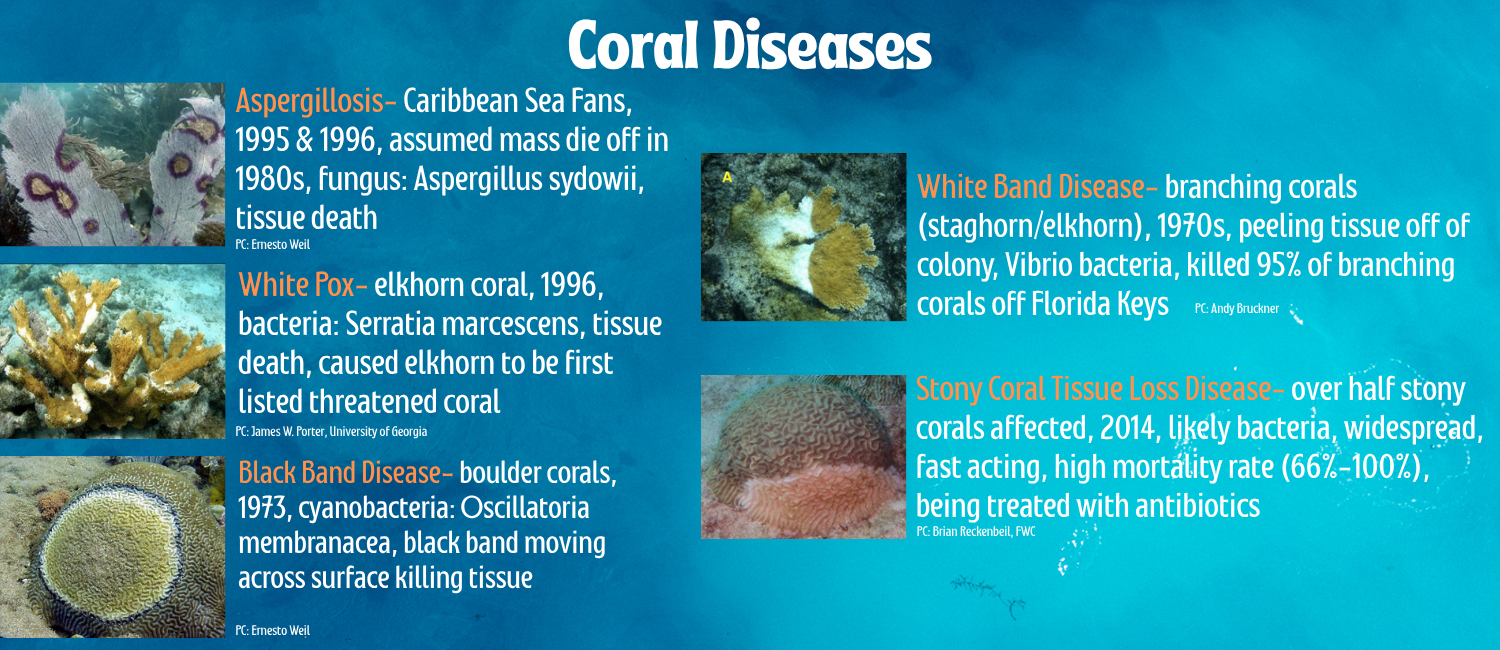
Oftentimes coral diseases causes by a variety of pathogens including bacteria, fungus, parasites, and viruses, are caused by or made worse by anthropogenic influences such as pollution and climate change. Some coral diseases found in the Florida Keys over the past decades include Aspergillosis, White Pox, Black Band, White Band, and most recently Stony Coral Tissue Loss Disease (SCTLD).
Climate Change
Climate change is a change in global or regional climate patterns, in particular a change apparent from the mid to late 20th century onwards, attributed largely to the increased levels of atmospheric carbon dioxide produced by the use of fossil fuels. When we burn fossil fuels like oil, coal, and gas to create energy to do things like drive our cars and turn on our lights or even make plastic, we release greenhouse gasses (carbon dioxide, methane, nitrous oxide, water vapor) into the atmosphere. These gasses do not just float away into space but become trapped in our atmosphere leading to the greenhouse effect. When sunlight enters our atmosphere, some energy is reflected back into space and some is absorbed and reradiated as heat. These gasses trapped in the atmosphere act like the glass of a greenhouse, allowing sunlight to enter, but trapping the radiant heat inside leading to a wide variety of negative effects. Climate change affects reefs by driving an increase in the frequency and intensity of coral bleaching events that kill corals and ocean acidification impacting corals’ ability to build and maintain their limestone skeletons.